
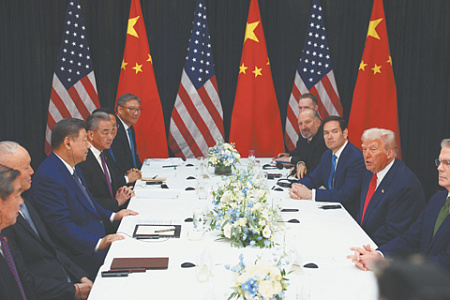
A high-stakes encounter between U.S. President Donald Trump and Chinese President Xi Jinping in Busan, South Korea, overshadowed all other discussions at the Asia-Pacific Economic Cooperation (APEC) summit. While President Trump lauded their conversation as “amazing” and President Xi emphasized the need for friendship between their nations, the highly anticipated talks yielded no substantive breakthroughs on contentious issues like tariffs or other long-standing disputes, casting a shadow of uncertainty over future relations. This delicate equilibrium is widely expected to persist only until the U.S. Congressional elections in 2026, after which Washington might intensify sanctions against Beijing to appeal to a specific segment of the American electorate.
Returning from South Korea, President Trump reportedly rated his discussion with Xi a ’12’ on a 10-point scale, a testament to its perceived significance. Theoretically, this meeting could have stabilized the often-turbulent U.S.-China relationship, recently strained by disagreements over tariffs, the illicit trafficking of fentanyl components into the U.S. via Mexico, and the perennial issue of Taiwan. Trump, describing Xi as a “tough negotiator,” claimed to have made a concession by reducing tariffs on Chinese imports from 57% to 47%. The leaders also touched upon the crisis in Ukraine, with Trump indicating further discussions with China on the matter. The one-hour-and-forty-minute meeting marked their first face-to-face interaction in six years.
Analysts in the United States underscored the critical need for this meeting for both global powers. Trump’s aggressive use of tariffs had been met with China’s retaliatory restrictions on rare earth exports, creating a mutually damaging cycle. Beijing and Washington both acknowledged that continued economic warfare would ultimately harm their respective economies.
During their dialogue, President Xi put forward several proposals for Trump’s consideration. These included collaborative efforts against illegal immigration, fraud, and money laundering; cooperation in the burgeoning field of artificial intelligence; and joint action to combat infectious diseases. The Chinese President stressed that as two responsible members of the international community, the U.S. and China should broaden their engagement on the global stage, a sentiment underscored by China’s upcoming hosting of the APEC summit next year and the U.S. hosting the G20 summit.
While immediate official comments from Beijing were not forthcoming following the meeting, the fentanyl issue has long been a particular point of irritation for China. Beijing had previously agreed with former U.S. President Joseph Biden to cooperate on stemming the flow of fentanyl ingredients to Mexico. Trump’s re-raising of the issue was seen by some as undermining the atmosphere of trust crucial for bilateral cooperation.
Speaking to NG, Alexander Lomanov, Deputy Director of IMEMO RAS, expressed skepticism about the longevity of any agreements: “I believe the agreements reached in South Korea will, at best, last for six months. Then, with the upcoming Congressional elections in America, Trump will feel compelled to impress his voters. The temptation to pressure China will resurface. The current fragile balance will be shattered, and everything will start anew.” Lomanov further asserted that the trade war, particularly the rivalry in technology and microchips, is not a matter of years but decades. He highlighted the 47% tariffs as exceedingly high, designed to suppress rather than stimulate trade, emblematic of ongoing economic conflict.
Alexander Lukin, Scientific Director of the Institute of China and Contemporary Asia of the Russian Academy of Sciences, echoed concerns about the fragility of the consensus. “China is convinced that relations with the U.S. must be based on the principle of equality. Beijing will not tolerate any pressure from Washington,” Lukin commented. He also noted that this principle extends to China’s independent foreign policy, stating, “China will continue to purchase oil from Russia based on its own needs.”
In essence, the Busan summit appears to have offered a temporary reprieve rather than a definitive resolution to the deep-seated strategic and economic tensions between the United United States and China. The underlying currents of rivalry, fueled by technological competition and differing geopolitical aspirations, suggest that the “amazing” pause may well be a prelude to renewed confrontation.