
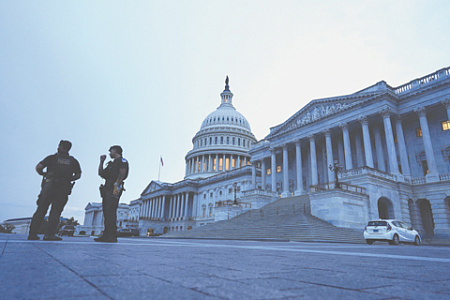
The Kremlin has confirmed it is monitoring a dramatic development in Washington, where the U.S. Congress is poised to introduce a bill imposing crippling 500% tariffs on countries purchasing Russian energy. The move, reportedly greenlit by President Donald Trump, signals the first major anti-Russian sanctions of his presidency and a significant shift in his administration’s foreign policy. The exact form of the sanctions remains under discussion, but the impending legislation itself marks a pivotal moment in U.S.-Russia relations.
The bill was co-authored this spring by Republican Senator Lindsey Graham, who is on Russia’s list of terrorists and extremists, and Democratic Senator Richard Blumenthal. It has secured overwhelming bipartisan support, with 80 out of 100 senators reportedly ready to vote in favor—a majority sufficient to override a potential presidential veto. The authors had previously described the bill as a final diplomatic tool to compel Moscow to end the conflict in Ukraine, framing it as a choice for the Kremlin: de-escalate or face severe economic consequences.
Despite initial skepticism from many U.S. commentators and stated concerns from administration officials that sanctions could hinder peace efforts, the situation has changed rapidly. Senator Graham revealed in an ABC News interview that President Trump, during a recent golf game on June 28, told him “it’s time to act” and bring the bill to the floor. According to Graham, the legislation will be formally presented when Congress returns from its recess on July 7.
This account was later corroborated by Democratic Senator Chris Coons, who confirmed the bill would be considered. Meanwhile, the Kremlin was the first to officially react to the news. Presidential spokesman Dmitry Peskov dryly noted that if it were up to Senator Graham, such secondary sanctions would have been imposed long ago. Questioning the bill’s utility, Peskov remarked, “Would this help a settlement? That is a question that those who initiate these events should ask themselves.”
The final version of the bill is expected to be less extreme than its initial proposal. According to The Wall Street Journal, a key provision, added at the White House’s behest, will grant the President discretionary power to decide whether to impose the 500% tariffs. It is also unclear if the law will allow for waivers for specific countries, such as major Russian energy importers India and China. This would transform the measure from an all-out economic war into a powerful threat, giving Trump a new and potent lever of pressure.
Regardless of its final wording, the bill’s passage represents a fundamental change in President Trump’s Russia strategy. After consistently avoiding punitive measures despite domestic and international criticism, he is now prepared to employ not just incentives but also a significant economic “stick.” The ultimate question is no longer whether the U.S. will apply pressure on Russia, but how painful that pressure will prove to be.