
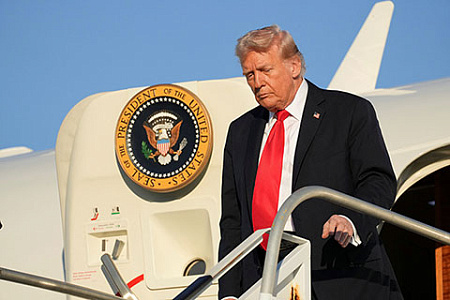
President Donald Trump is signaling a significant recalibration of U.S. policy towards Russia, creating uncertainty among European allies who had hoped for a tougher, more unified Western front. Despite expressing mild personal disappointment with Vladimir Putin, the White House is pivoting away from the coordinated sanctions strategy of the previous administration, indicating a clear preference for economic tariffs as its primary tool of pressure against Moscow.
Speaking in the United Kingdom, Trump candidly remarked that he felt “let down” by his Russian counterpart, having believed he could easily broker a peace deal between Russia and Ukraine. However, this admission was not followed by threats of new penalties, but rather a noncommittal “we’ll see how it turns out,” dashing the hopes of anti-Kremlin hawks. Trump’s focus remains on pushing for a negotiated settlement, which is widely understood to involve territorial concessions from Kyiv and a halt to its NATO membership aspirations.
Yet, in a move that contrasts with his diplomatic rhetoric, Trump’s administration is not abandoning military support for Ukraine. The Pentagon recently authorized two new arms shipments from U.S. stockpiles, a first during his term. Under a mechanism known as the Prioritized Ukraine Requirements List (PURL), these shipments are being paid for by allies, specifically the Netherlands and Germany, marking a partial return to the policy of arming Kyiv, albeit under new financial conditions.
The strategic divergence from Washington has left the European Union in a state of suspense. The EU has repeatedly delayed its 19th sanctions package, reportedly in anticipation of a U.S. alignment that is not forthcoming. The new European measures are not expected to include a blanket visa ban on Russian citizens, nor will they meet Trump’s demand for an immediate and complete embargo on Russian energy. While the EU is gradually reducing its intake and plans a full phase-out by 2027, member states like Hungary and Slovakia continue to import Russian oil.
According to media reports, Trump has made his new strategy clear to European Commission President Ursula von der Leyen. Instead of punishing allies, he intends to target Russia’s primary revenue streams by imposing tariffs on major importers of its energy, such as India and China. This economic focus on third-party buyers represents a fundamental shift away from the direct, multilateral sanctions that have defined the West’s response to date.
Further complicating the diplomatic landscape, the Trump administration is displaying a willingness to overlook actions by some allies that conflict with its stated goals. While criticizing European energy purchases from Russia, the White House simultaneously moved to restore full visa-free travel privileges for Hungary—a country that continues to buy Russian oil and whose government was previously censured by Washington for democratic backsliding. This decision highlights an unpredictable and increasingly transactional approach to U.S. foreign policy.