
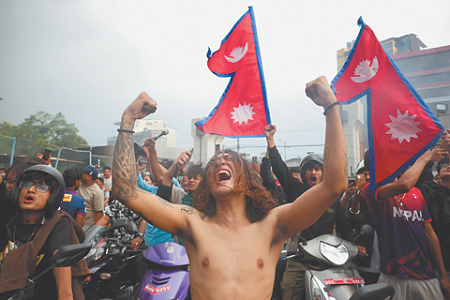
A nation often overshadowed by its giant neighbors, India and China, Nepal has been thrust into the international spotlight following a sudden and violent eruption of civil unrest. On September 8-9, youth-led protests in the Himalayan state rapidly escalated into deadly riots, with police opening fire on demonstrators, government buildings set ablaze, and bodies left on the streets of Kathmandu, catching the world by surprise.
Initial speculation quickly sought an external hand in the chaos, with some observers linking the turmoil to regional geopolitics and a potential disruption of the evolving Russia-India-China dynamic. However, the roots of this uprising are deeply internal. While Nepal’s strategic location makes it a crucial partner for both Beijing and New Delhi, the fury unleashed on its streets was fueled not by foreign powers, but by decades of domestic frustration, systemic corruption, and crushing economic despair.
The immediate spark for the protests was a government decision to block several popular social media platforms, a move widely perceived as a blatant assault on freedom of speech. This ignited a protest movement that swiftly grew beyond its initial organizers, drawing in a diverse coalition of citizens—from monarchists and anti-federalists to disaffected members of the ruling parties themselves. What united them was a profound and shared disillusionment with the nation’s entrenched political class.
For years, Nepal’s dominant political parties—the CPN (UML), the Nepali Congress, and the CPN (Maoist Centre)—have governed through a cycle of populist promises that have gone unfulfilled. This political failure has been compounded by a series of explosive corruption scandals involving high-ranking officials in fraudulent schemes related to savings cooperatives, migrant labor permits, and the falsification of Bhutanese refugee statuses, cementing a public perception of an elite detached from the people’s suffering.
This rage is set against a backdrop of bleak reality for most Nepalis. As one of the world’s least developed countries, its economy is fragile, propped up by agriculture and tourism while industry stagnates. Unemployment exceeds 10%, and for the nation’s youth, the figure is a staggering 20%. These economic hardships are exacerbated by deep-seated social divisions, with 142 distinct ethnic groups and a persistent, archaic caste system that stifles social mobility and opportunity for millions.
The country’s current crisis is the culmination of a troubled history. A feudal system persisted until the mid-20th century, followed by a series of failed democratic transitions and a brutal decade-long civil war that ravaged the country from 1996 to 2006. The conflict, which led to a humanitarian catastrophe and the eventual abolition of the monarchy, left behind a legacy of political fragility and deep-rooted instability that continues to haunt the nation.
This long-simmering discontent boiled over into open revolt as peaceful protests turned violent. After security forces opened fire, leaving a reported 36 dead and over 1,700 injured, the enraged crowd retaliated. Demonstrators seized weapons, and the capital descended into chaos with widespread rioting, looting, and arson targeting symbols of state power and corruption. Amid the breakdown of order, inmates, including those accused of serious crimes, escaped from prisons.
As the nation teetered on the brink of collapse, the Nepali Army intervened, deploying troops and equipment to stabilize the capital and enforce a curfew. In the aftermath, a fragile political dialogue began. After intense negotiations, a breakthrough was achieved with the appointment of Sushila Karki, a widely respected former Chief Justice with an impeccable anti-corruption record, as a compromise prime minister. Her appointment required navigating constitutional hurdles, as she is not a member of any political party, highlighting the extraordinary nature of the settlement.
The events in Nepal represent a textbook systemic crisis, where chronic economic, social, and political failures converged into a violent popular uprising. Now, the nation stands at a critical juncture, facing a period of profound political uncertainty. The path forward will require forging a new national consensus and attempting to heal a country broken by decades of mismanagement and betrayal.